Ensuring Certain Employees are Exempt Will Now Cost Employers an Extra $8,320

by | May 31, 2024

Taking effect July 1, 2024 is the Federal Department of Labor’s increase in the minimum salary thresholds for executive, administrative and professional employees to qualify for the “exempt” classification. Remember that the individuals will still need to meet the “duties” test for each of these qualified exemptions as well. What does this new threshold mean for employers?

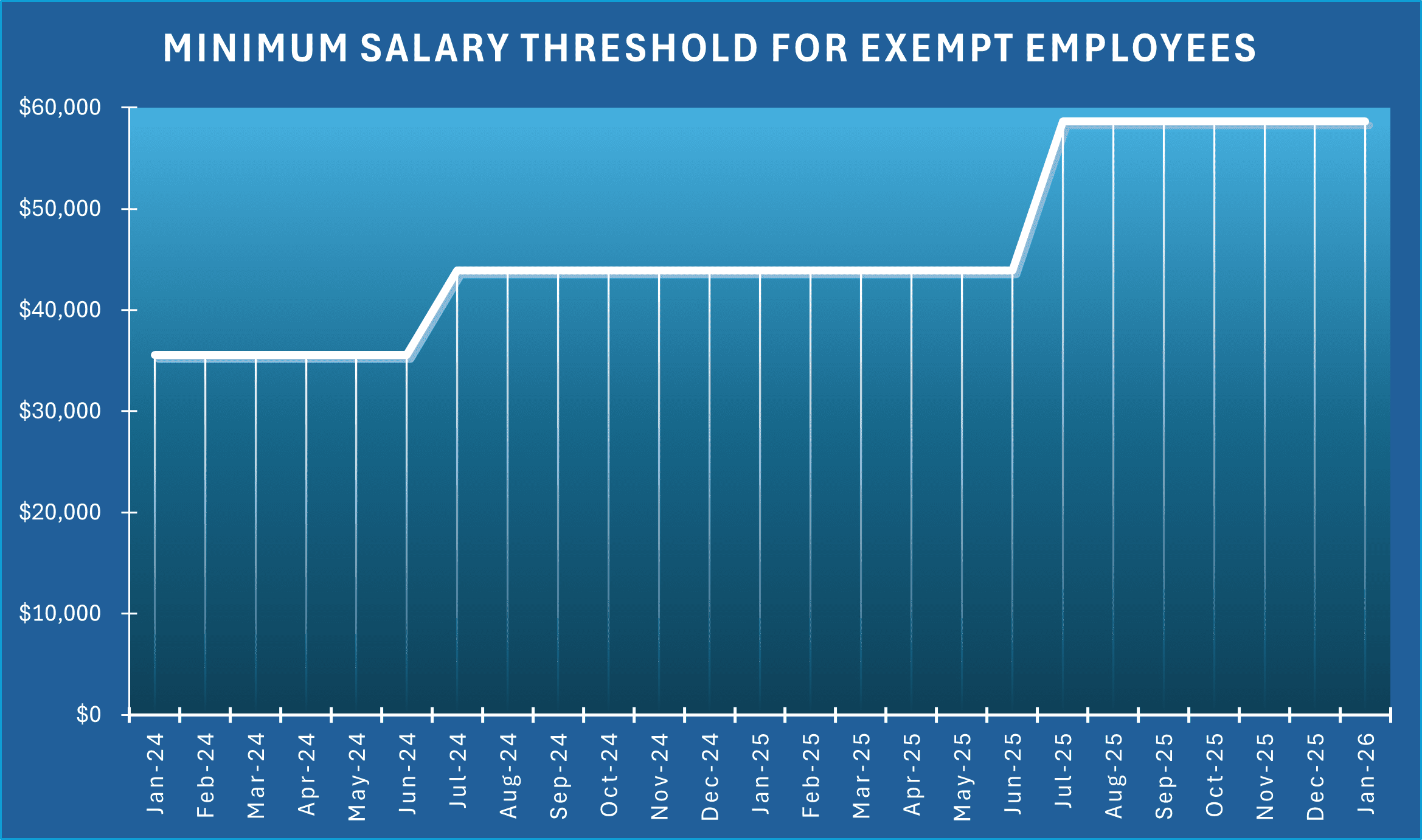
Let’s say you’re paying your exempt workers a salary now (i.e., pre-July 1, 2024) at the rate of $684/week ($35,568/year). On July 1, 2024, your choice is to bump their annual salary by $8,320.00 to $844/week ($43,888/year) or start paying overtime for every hour worked over 40 in a workweek.

And just when you’ve adjusted your annual budgets to meet those increases, be prepared for July 1, 2025, when another $14,768 per year increase to meet the weekly minimums will be effective requiring $1,128/week ($58,656/year).

There’s a bit of a reprieve until July 1, 2027, when the feds plan to adjust the earnings thresholds. Beyond that point, the DOL will update the thresholds every three years.

Failure to meet these thresholds may mean the employee is entitled to overtime pay if they work more than 40 hours in a workweek.

Need help figuring this out? Contact an RKW employment lawyer who can discuss options for your business and budget.

Author Profile

Laura L. Rubenstein
Laura L. Rubenstein
‍Laura L. Rubenstein heads RKW’s Labor and Employment practice group. She represents employers, providing education on compliance with a goal of avoiding the courtroom. Laura focuses on the defense of FLSA and state wage disputes, ADA accommodations, FMLA leave, harassment, discrimination and retaliation. Laura frequently drafts critical documents including employment contracts, restrictive covenants, and severance/separation agreements, and handles sensitive employment investigations, ensuring confidence throughout the process.

Laura counsels boards of directors and C-level executives on governance, policy and best practices. She also provides on-site training for managers, supervisors and executives to help reduce liability and promote a more harmonious and productive workplace.

Laura has handled hundreds of investigations by state and federal departments of labor, the EEOC, and other federal and state agencies on matters related to harassment, discrimination, wage claims, independent contractor disputes, employee classification and other statutory claims.

Post Categories

Most Recent Articles

Keeping Tabs on the Agenda of the EEOC

Keeping Tabs on the Agenda of the EEOC

Shortly after taking office, President Trump swiftly reshaped the Equal Employment Opportunity Commission (EEOC), with changes that were, frankly, anticipated by employment lawyers who have watched the pendulum swing with each new administration. He dismissed the...

To DEI or Not

To DEI or Not

As you know from previous updates, a Maryland Federal Court enjoined President Trump’s Executive Order attempting to eliminate DEI initiatives. The Fourth Circuit Court of Appeals reversed the injunction for now while the issue continues to play out through the court...

Update on Implementation of Maryland’s FAMLI Law

Update on Implementation of Maryland’s FAMLI Law

On February 14, 2025, the Maryland Department of Labor (MD DOL) proposed delaying implementation of the upcoming Family and Medical Leave Insurance (FAMLI) program suggesting that employers and workers need additional time to prepare for the launch. Under the new...