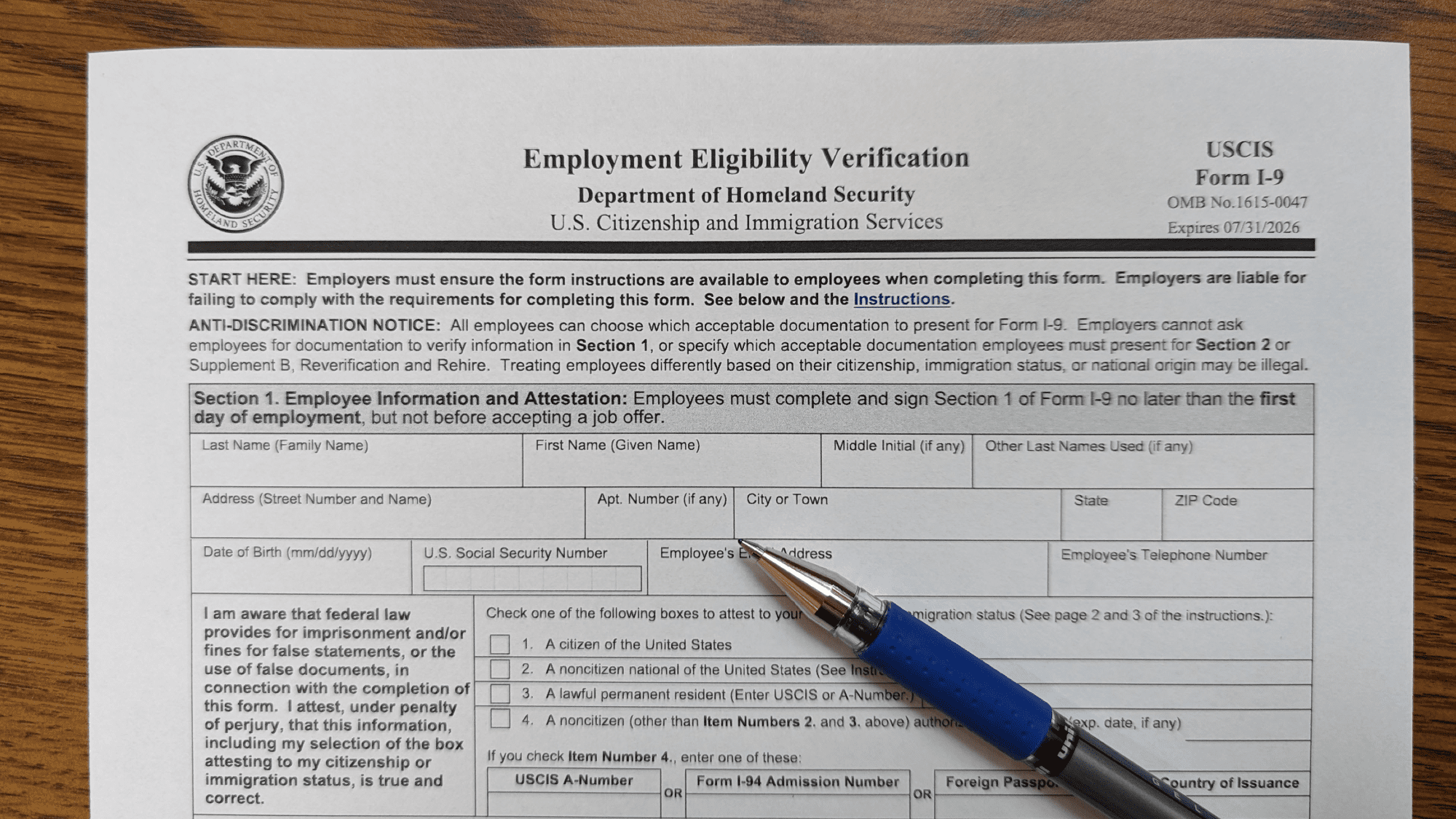
Most employers are aware that, upon a new employee’s hire, they have a duty under law to complete federal Form I-9, Employment Eligibility Verification, and require their new employee to do the same (and provide supporting documentation). Historically, the I-9 was required to be completed in-person; however, as a result of the COVID-19 pandemic, the Department of Homeland Security instituted new rules accommodating employers with remote workforces. Many assumed that, because the employment landscape had been permanently altered as a result of the pandemic, these relaxed restrictions would also be permanent.
Not so fast.
In a recent attempt to keep employers on their toes, DHS recently updated both (i) the actual Form I-9 used by employers in hiring employees, and (ii) the Form I-9 examination process.
What’s New with the I-9 Form?
Check it out for yourself here. Mostly, it’s more user-friendly: easily completable on an electronic device and shortened to a single sheet (the instructions also have been shortened). A few small tweaks here and there, but nothing that will make anybody lose sleep.
What’s Different about the I-9 Process?
Remote examination has become much more difficult. Employers are now required to have employees on-site to physically hand in Form I-9 supporting documents, unless employers follow the following procedure:
- Enroll in the E-Verify program and be in good standing;
- Create an E-Verify case, if the employee is a new hire;
- Examine the employee’s provided supporting documentation;
- Conduct a live video interaction with the presenting employee – during which the employee presents the same documents during the livestream as already provided;
- Indicate on Form I-9 that remote verification was used;
- Retain copies of all documentation.
But that’s not all!
To use the alternative procedure, employers must complete an E-Verify training. If the employer offers this alternative method for one employee, it must offer it to all remote employees. Most incredibly, if the employer completed remote inspection (not through E-Verify) of an employee’s supporting I-9 documents (for employees hired between March 20, 2020 and July 31, 2023), as was permitted by law, the employer must now conduct a physical, in-personal examination of all Form I-9 documents. This must be done by August 30, 2023!
There may be some relief on the horizon – DHS plans to publish a regulation allowing some alternatives to the in-person inspection requirement. Unless and until that happens, though, the new changes have taken effect as of August 1, 2023. Contact an RKW lawyer to assist you in ensuring your I-9 processes are being revised for legal compliance.